
The Hadzabe Community of Lake Eyasi
Most people picture Tanzania through a familiar lens. They imagine lions on the Serengeti plains. They picture wildebeest crossing a river in a cloud of dust. Tanzania, however, holds something else entirely: a living link to how all humans once lived.
Near the shores of Lake Eyasi, in the shadow of the Great Rift Valley, the Hadzabe community of Lake Eyasi still hunts with handmade bows. They still gather wild honey using the help of a wild bird. They still speak a language found nowhere else on Earth. For travelers seeking something beyond wildlife, a visit here offers one of the most meaningful cultural encounters in all of East Africa.
This guide walks you through who the Hadzabe are, how they live, and how to visit them with respect. Along the way, you will meet the neighboring Datoga people too. Together, these two communities make Lake Eyasi one of Tanzania’s most quietly extraordinary destinations.
Who Are the Hadzabe?

The Hadzabe, often called the Hadza, are an indigenous hunter-gatherer people living around Lake Eyasi in northern Tanzania. Researchers consider them descendants of some of the region’s earliest inhabitants. Their genetic lineage is among the oldest known to science, and their language has no confirmed relatives anywhere in the world.
Population estimates vary depending on the source, but most place the Hadzabe community between roughly 1,200 and 1,500 people. Of these, only a few hundred still live a fully nomadic, foraging lifestyle day to day. Many others now split their time between traditional camps and nearby settled villages, blending old and new ways of survival.
This is an important distinction. The Hadzabe are not frozen in time. Like every community on Earth, they are adapting to a changing world, even as they protect traditions that stretch back tens of thousands of years.
Did You Know? Archaeological evidence suggests people very similar to today’s Hadzabe have lived continuously in this landscape for at least 50,000 years, making theirs one of the longest unbroken human stories anywhere on the planet.
Where Is Lake Eyasi?
Lake Eyasi sits in the central Rift Valley of northern Tanzania, roughly 150 to 200 kilometers southwest of Arusha. The lake itself is a shallow, seasonal soda lake, ringed by purple lava cliffs and dry acacia woodland. During the wet season, its waters draw flamingos, pelicans, and storks. In the dry season, much of the lakebed turns to cracked white salt flats.
The surrounding landscape is rugged and arid, dotted with baobab trees and scrubby bushland. It feels different from the lush wildlife parks most visitors associate with northern Tanzania, and that contrast is part of its appeal.
Most travelers reach Lake Eyasi by road, usually from Arusha. The drive takes around 4 to 5 hours, passing through the town of Karatu along the way. The route is paved as far as Karatu; after that, the final stretch becomes a rougher dirt road, so a 4×4 vehicle is strongly recommended, particularly during the rains.
Lake Eyasi connects naturally to Tanzania’s Northern Safari Circuit. It lies close to Ngorongoro Crater, within reach of Lake Manyara, and not far from the southern edges of the Serengeti. Because of this, most visitors combine a Hadzabe cultural visit with a broader northern Tanzania safari rather than treating it as a standalone trip.
History of the Hadzabe
The Hadzabe’s roots in this landscape run extraordinarily deep. Their homeland lies close to Olduvai Gorge, often called the Cradle of Mankind, and to Laetoli, where some of the earliest known hominin footprints were discovered. While the Hadzabe are not descendants of those specific early hominins, their continued presence in this same region underscores just how long humans have called this corner of the Rift Valley home.
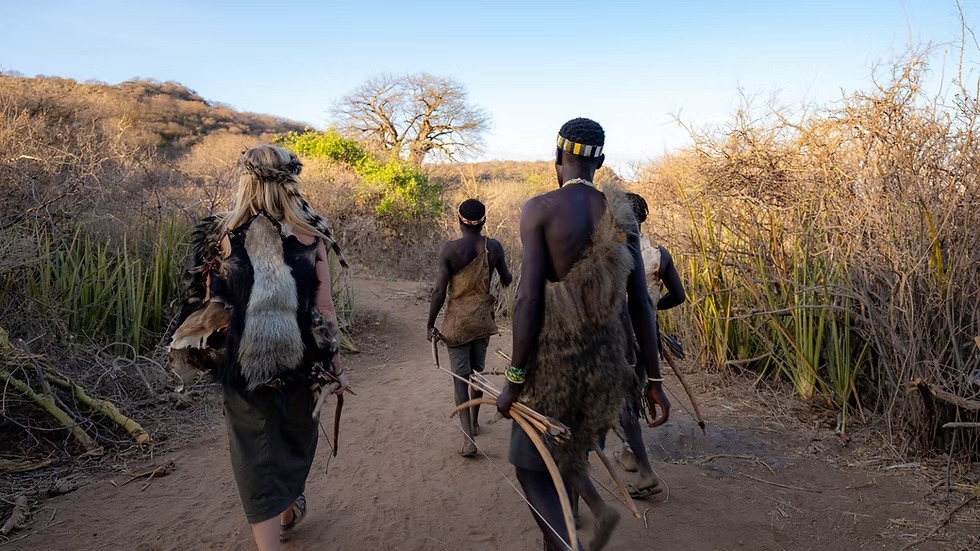
Oral tradition, rather than written history, carries the Hadzabe story forward. Elders pass knowledge to younger generations through stories told around the fire, not through books or archives. This oral continuity has preserved hunting techniques, plant knowledge, and cultural values across countless generations.
For centuries, the Hadzabe lived with little outside contact. That changed gradually as neighboring groups, including the pastoralist Datoga and Maasai, expanded into the wider region from the 19th century onward. Today, the Hadzabe maintain trade relationships with the Datoga, exchanging honey and animal skins for metal arrowheads forged by Datoga blacksmiths.
European contact began in the late 1800s, followed by repeated government attempts throughout the 20th century to settle the Hadzabe into farming villages. Colonial administrators tried in 1927 and again in 1939. The independent Tanzanian government attempted similar resettlement programs in 1965 and 1990. Each time, many Hadzabe eventually returned to the bush, choosing to continue the life their ancestors had always known.
Daily Life Among the Hadzabe
A Hadzabe day typically begins at first light. Men often set out early to hunt, while women head out, frequently in groups, to gather fruits, tubers, and other wild foods. There is no rigid schedule here. Activity follows the rhythm of the land, not the clock.
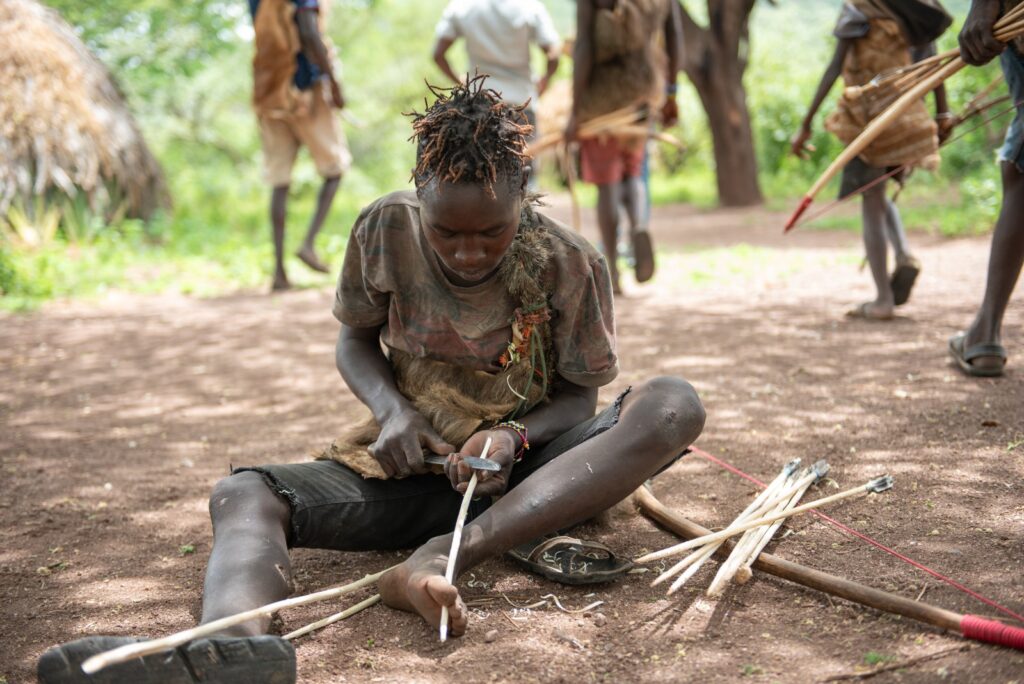
Camps are small and intentionally temporary, usually housing between twenty and thirty people. Families build simple shelters from dried grass, branches, and animal hides, structures that can be assembled in a single afternoon and abandoned just as easily. When local resources run low, the camp moves. This mobility lies at the heart of Hadzabe survival.
Family life centers on close cooperation. Childcare is often shared across the group rather than confined to individual households. Children learn essential skills by watching and imitating adults, picking up tracking, fire-making, and foraging abilities from an early age rather than through formal instruction.
Decision-making works the same way: collectively. The Hadzabe have no chiefs, no kings, and no formal hierarchy. Anthropologists who have studied the community describe it as strikingly egalitarian, with resources shared widely and status differences actively discouraged.
Hunting Traditions of the Hadzabe
Hunting remains central to Hadzabe identity, even as its role in daily nutrition has shifted over time. Men hunt using handcrafted bows and arrows, often coating their arrowheads with a poison derived from the desert rose plant to help bring down larger game.
Targets vary by season and opportunity. Guinea fowl and other birds are common catches, alongside small game like dik-dik. Larger animals are pursued too, though far less predictably. Tracking skill matters more than firepower here; a skilled Hadzabe hunter can read footprints, broken branches, and disturbed soil with remarkable precision.
Honey hunting holds a special place in Hadzabe culture, valued by many even above meat. To find hives, hunters rely on an extraordinary partnership with a wild bird called the greater honeyguide. This bird actively leads Hadzabe foragers to beehives through specific calls and flight patterns. In return, the Hadzabe leave behind wax and larvae for the bird to feed on, a genuine example of mutualism between humans and wildlife.
Boys begin learning these skills remarkably early, sometimes by the age of five or six. They start by observing, then gradually take on small tasks, slowly absorbing a body of ecological knowledge that takes years to master fully.
Gathering and Wild Foods
While hunting captures most outside attention, gathering actually provides the larger share of the Hadzabe diet. Women lead this work, often traveling in groups to forage across the bush.
Berries, wild fruits, and tubers form the backbone of daily meals. Baobab fruit, rich in vitamin C, is especially prized and used in multiple ways throughout the year. Honey, as already noted, ranks as a favorite among all foods available to the community.
Seasonal change shapes what is available. Certain berries appear only at specific times of year, while tuber digging becomes more important during leaner months when other food sources are scarce. This deep, practical knowledge of seasonal cycles allows the Hadzabe to survive in an environment that might appear harsh or unforgiving to an outside observer.
Medicinal plants round out this picture. Hadzabe elders maintain extensive knowledge of which plants treat which ailments, knowledge built and refined over countless generations of trial, observation, and oral transmission.
Did You Know? Researchers have found that the Hadzabe gut microbiome is significantly more diverse than that of people living in industrialized societies, a finding many scientists link directly to their varied, wild-foraged diet.
The Hadzane Language
The Hadzabe speak Hadzane, a language built around distinctive click consonants. Although these clicks sound similar to languages spoken by the Khoisan peoples of southern Africa, linguists classify Hadzane as a true isolate. In other words, it has no confirmed relatives anywhere else on the planet.
Hadzane exists entirely as a spoken language, with no traditional written form. As a result, storytelling carries enormous cultural weight. History, values, and practical knowledge all travel from one generation to the next through spoken word alone.
This oral foundation makes the language particularly vulnerable. As younger Hadzabe increasingly attend Swahili-language schools, some linguists have raised concerns about the long-term survival of Hadzane itself, alongside the broader cultural knowledge it carries.
Music, Dance, and Storytelling
Music and dance bring the Hadzabe community together, especially during evening gatherings around the fire. Songs often accompany storytelling sessions, where elders share oral history, moral lessons, and entertaining tales in equal measure.
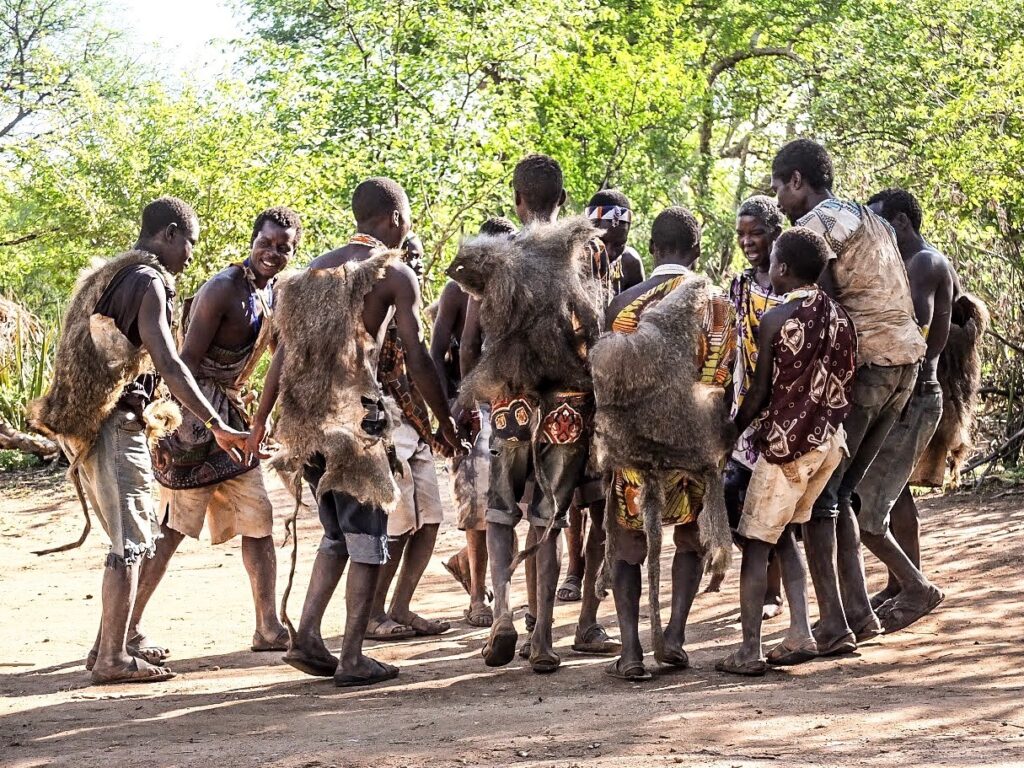
Celebrations mark significant moments, from successful hunts to important life transitions. These gatherings reinforce social bonds and pass cultural knowledge to younger members of the community in a way that feels participatory rather than instructional.
For visitors, witnessing even a small piece of this tradition offers genuine insight into Hadzabe values. The emphasis falls consistently on shared experience rather than performance for its own sake.
Traditional Clothing and Tools
Traditional Hadzabe clothing has historically included animal skins, particularly for ceremonial occasions, although many community members today also wear modern fabric clothing for daily activities. Handmade jewelry, often crafted from beads, bone, or natural materials, remains a visible expression of personal and cultural identity.
Everyday tools reflect practical necessity above all else. Knives, used for everything from food preparation to craft work, are essential possessions. Fire-making relies on traditional friction methods, a skill every Hadzabe person learns from childhood.
Bows and arrows remain the most iconic Hadzabe tools, carefully crafted and maintained. Because the Hadzabe do not produce their own metal, they trade with the neighboring Datoga to obtain arrowheads, an exchange that has continued for generations and reflects a broader pattern of interdependence between the region’s communities.
The Visitor Experience
Visiting the Hadzabe community offers something genuinely different from a typical safari activity. Rather than observing wildlife from a vehicle, you walk directly alongside Hadzabe guides through their home landscape.
Most visits begin early, often before sunrise, since hunting activity is most active in the cool morning hours. A local guide leads you on a bush walk, during which Hadzabe hosts may demonstrate tracking techniques, explain plant uses, or show how they read animal signs across the terrain.
Hunting demonstrations are common, though it is worth noting that an actual kill is never guaranteed and should never be the expectation. Genuine hunting depends entirely on chance encounters with game; what visitors witness is the skill and method behind the practice, not a staged performance.
Fire-making demonstrations, using traditional friction techniques, often follow. Visitors frequently get the chance to try the technique themselves, usually with considerably less success than their hosts, which tends to become a memorable and humbling moment.
Honey collection, when in season, offers another highlight. Watching a Hadzabe hunter climb a baobab tree and work alongside a honeyguide bird is a rare privilege, one that highlights the depth of ecological knowledge built into daily Hadzabe life.
Throughout all of this, the focus should remain firmly on learning rather than entertainment. The best visits feel like a genuine exchange, not a show staged purely for cameras.
Sustainable Tourism with the Hadzabe
Responsible travel matters enormously here. Tourism can provide real economic benefit to the Hadzabe community, but only when structured thoughtfully and managed with the community’s genuine participation and consent.
Choose tour operators who work directly with Hadzabe guides and who can clearly explain how visit fees reach the community. Avoid operators who treat visits as quick photo opportunities rather than meaningful cultural exchanges.
Ethical photography matters too. Always ask permission before photographing individuals, even when a moment feels candid and natural. Most Hadzabe community members are comfortable being photographed once asked respectfully, but consent should never be assumed.
Respectful engagement also means approaching the visit with humility. This is not a recreation of the past performed for entertainment; it is a living community navigating real, present-day choices about how to balance tradition with change. Treating the experience this way honors both your hosts and the authenticity of what they are sharing with you.
Challenges Facing the Hadzabe
The Hadzabe face significant, ongoing challenges, and presenting their situation honestly matters more than romanticizing it.
Land rights remain a central concern. Over recent decades, the Hadzabe have lost a substantial portion of their traditional territory to expanding agriculture, pastoralist herding, and, at times, conservation area boundaries that restrict traditional movement and hunting access. Some progress has occurred; in 2011, a Hadzabe community received formal land titles covering more than 20,000 hectares, marking a historic moment for indigenous land recognition in Tanzania.
Modernization brings both opportunity and disruption. Many Hadzabe families want their children to attend school, yet schooling typically requires boarding away from the community for most of the year, taught in Swahili by teachers from outside the culture. This creates a genuine tension between education access and cultural continuity.
Climate variability adds further pressure. Unpredictable rainfall affects the availability of wild foods and water sources the Hadzabe depend on directly, with fewer buffers available to absorb environmental shocks compared to communities engaged in agriculture or livestock keeping.
Tourism itself cuts both ways. Done well, it provides income and broader visibility for Hadzabe land rights advocacy. Done poorly, it can disrupt daily life, encourage performative rather than authentic cultural display, or funnel benefits away from the community itself.
Healthcare access remains limited in this remote region, contributing to ongoing public health challenges. None of these pressures define the Hadzabe as a community frozen in crisis, however. Instead, they reflect the same complex balancing act facing indigenous communities worldwide: how to preserve cultural identity while engaging, on their own terms, with a rapidly changing surrounding world.
Best Time to Visit Lake Eyasi
The dry season, running roughly from June through October, offers the most reliable conditions for visiting the Hadzabe. Roads are easier to navigate, and the drier landscape makes bush walks and tracking more comfortable.
The green season, from November through May, transforms the landscape with lush vegetation and fuller water levels in Lake Eyasi itself, drawing impressive numbers of birds. However, travel becomes more challenging, with muddier roads and reduced accessibility in places.
Photography conditions vary by season too. Dry season light tends to be clearer and starker, well suited to portrait and landscape work. Wet season visits offer greener backdrops and excellent birdlife photography opportunities around the lake itself.
Cultural visits with the Hadzabe remain possible year-round, since their daily activities continue regardless of season. Choosing when to visit, therefore, depends more on your broader Tanzania itinerary and weather preferences than on any restriction tied to the Hadzabe community itself.
Nearby Attractions
Lake Eyasi sits conveniently close to several of Tanzania’s most celebrated destinations, making it easy to combine with a broader northern circuit itinerary.
Ngorongoro Crater lies a relatively short drive away, offering some of Africa’s most concentrated wildlife viewing within a single, dramatic volcanic caldera. Serengeti National Park extends further north, world-famous for the Great Migration and endless plains teeming with wildlife. Lake Manyara National Park, known for its tree-climbing lions and dense birdlife, sits along the same general route between Arusha and Eyasi. Tarangire National Park, celebrated for its enormous baobab trees and large elephant herds, offers another natural addition to a Lake Eyasi itinerary.
The Datoga community, living near the Hadzabe around Mang’ola, rounds out the cultural side of the region. Unlike the Hadzabe, the Datoga practice pastoralism and are renowned for their blacksmithing skills, forging arrowheads, jewelry, and tools using traditional techniques passed down through generations. Many itineraries combine a Hadzabe morning visit with a Datoga afternoon stop, offering a fuller picture of the region’s cultural diversity.
Throughout the area, the dramatic backdrop of the Great Rift Valley frames every view, a geological reminder of just how ancient this landscape, and the people who call it home, truly are.
Travel Tips for Visiting Lake Eyasi
A few practical pointers will help your visit go smoothly and respectfully.
Book through a licensed cultural tourism guide or established safari operator with direct, transparent relationships with Hadzabe communities. Independent, self-guided visits are not appropriate here and are generally not permitted.
Wear sturdy, comfortable walking shoes, since bush walks can cover uneven terrain at a brisk pace. Bring water and sun protection, as the Eyasi basin can get extremely hot, particularly during the dry season.
Dress modestly and avoid clothing in very dark colors, which can attract tsetse flies common in parts of the region. Carry cash in small denominations if you wish to purchase handmade crafts directly from Hadzabe or Datoga artisans.
Allow more time than you think you need. Rushing through a visit undermines the entire purpose of the experience. A morning alone is rarely enough to absorb everything on offer here.
Finally, approach the day with curiosity rather than expectation. Genuine encounters, not staged performances, are what make a Hadzabe visit memorable.
Frequently Asked Questions
Who are the Hadzabe people? The Hadzabe are an indigenous hunter-gatherer community living around Lake Eyasi in northern Tanzania, recognized as one of the last fully hunter-gatherer societies remaining in Africa.
How many Hadzabe people are there today? Estimates generally place the total Hadzabe population between approximately 1,200 and 1,500 individuals, though only a few hundred still live a fully nomadic, foraging lifestyle.
What language do the Hadzabe speak? They speak Hadzane, a unique click language considered a linguistic isolate, meaning it has no confirmed relation to any other language on Earth.
Is it ethical to visit the Hadzabe tribe? Yes, when done responsibly through licensed guides who maintain transparent, respectful relationships with the community and ensure that tourism revenue genuinely benefits Hadzabe families.
How do I get to Lake Eyasi from Arusha? The drive typically takes around 4 to 5 hours by road, traveling through Karatu before reaching the rougher final stretch toward Lake Eyasi.
Can I combine a Hadzabe visit with a Serengeti or Ngorongoro safari? Yes, Lake Eyasi sits close to Tanzania’s Northern Safari Circuit, making it straightforward to combine with visits to Ngorongoro Crater, the Serengeti, or Lake Manyara.
Will I see an actual hunt during my visit? You may witness a hunting demonstration, but an actual kill is never guaranteed, since hunting success depends entirely on real, unscripted encounters with wildlife.
What is the difference between the Hadzabe and Datoga tribes? The Hadzabe are hunter-gatherers with no agriculture or livestock, while the Datoga are pastoralists known for cattle herding and skilled blacksmithing, living in the same general area.
What should I wear when visiting the Hadzabe? Modest, comfortable clothing in lighter colors works best, paired with sturdy walking shoes suited to bush terrain.
Is Lake Eyasi worth visiting on a Tanzania safari? For travelers interested in cultural depth alongside wildlife viewing, Lake Eyasi offers one of Tanzania’s most genuine and educational cultural experiences.
Further Reading
For readers interested in deeper academic and advocacy perspectives on the Hadzabe, the following resources offer valuable further context: Survival International’s ongoing coverage of Hadza land rights and community advocacy, the Minority Rights Group’s detailed profile of Hadza/Hadzabe history and contemporary challenges, and The Hadza: Hunter-Gatherers of Tanzania by anthropologist Frank Marlowe, a comprehensive academic study of Hadzabe social structure, behavioral ecology, and culture.
Plan Your Cultural Safari
A trip to see the Hadzabe community at Lake Eyasi offers something a wildlife-only safari simply cannot: a direct, humbling encounter with one of humanity’s oldest living cultures. You leave not just with photographs, but with a different sense of how people can live in genuine balance with the land around them.
Approach this visit with respect, curiosity, and an open mind, and it may well become the most memorable part of your entire Tanzania journey. If you are planning a northern Tanzania safari, consider building in a day at Lake Eyasi alongside your Serengeti, Ngorongoro, or Tarangire itinerary. Reach out to a responsible Tanzania safari operator today, and ask specifically about ethical, community-led visits to the Hadzabe and Datoga people. Few experiences in Africa offer this much depth, and even fewer offer this much honesty about what it truly means to be human.
Meta description: Discover the Hadzabe community of Lake Eyasi, Tanzania’s last hunter-gatherers. Learn their history, traditions, and how to visit respectfully on your Tanzania safari.